
Platform
Inference Stack Platform
An application-layer execution control platform that standardizes how AI systems are designed, hardened, and operated in production.
The platform operates at the application layer, between models, tools, and business systems, where runtime behavior is classified, validated, and enforced before it impacts production environments.
It is not a single product. It is a reusable execution foundation that compresses time-to-production, reduces systemic risk, and establishes durable standards across AI initiatives.
Executive summary of the AI Accelerator Platform
What this is
Application-layer execution infrastructure for assistants, agents, and AI-backed systems across enterprises.
What it replaces
Eliminates isolated pilots and fragmented architecture in favor of a shared execution base.
Who it's for
Enterprise product, technology, and portfolio operators accountable for AI performance and risk.
Why it matters
Because AI must behave predictably under institutional scrutiny, not just in demonstrations.
Why most AI initiatives stall
AI initiatives rarely fail for lack of ambition. They fail because each effort rebuilds architecture, standards, and runtime controls from scratch, without a shared execution substrate.
For leadership, this manifests as extended timelines, escalating spend, and AI systems that never fully transition from prototype to production asset.
Before a Platform
AI initiatives behave like isolated projects, each one relearning the same lessons from scratch.
- One-off architectures that are difficult to support and scale.
- Long discovery cycles before anything reaches real users.
- Control and risk discovered late, often at the point of launch.
- Spend accumulates without corresponding production readiness.
With the AI Accelerator Platform
Initiatives draw from a shared foundation, so effort concentrates on the specific business problem.
- Known execution patterns that reduce design thrash between teams.
- Shorter, more predictable timelines to production-grade outcomes.
- Execution standards and runtime controls embedded from the start.
- Spend that compounds as each product extends the same platform.
A reusable foundation for serious AI execution
The Inference Stack platform institutionalizes execution knowledge, from experimentation patterns to production hardening, and makes it available across every new AI build.
Instead of rebuilding the same patterns for every initiative, the platform provides a consolidated foundation for AI products, workflows, and assistants. It captures hard-won execution knowledge—from how to structure experiments to how to harden them for production—and makes it available on every new build.
The outcome is a shift from AI as a series of disconnected trials to AI as a managed, scalable capability that can be applied across business units, regions, and portfolio companies.
A shared foundation beneath every AI product
Multiple AI products sit on a common execution foundation. The platform absorbs the complexity that would otherwise be rebuilt in every initiative, which is what enables speed, safety, and repeatability across the portfolio.
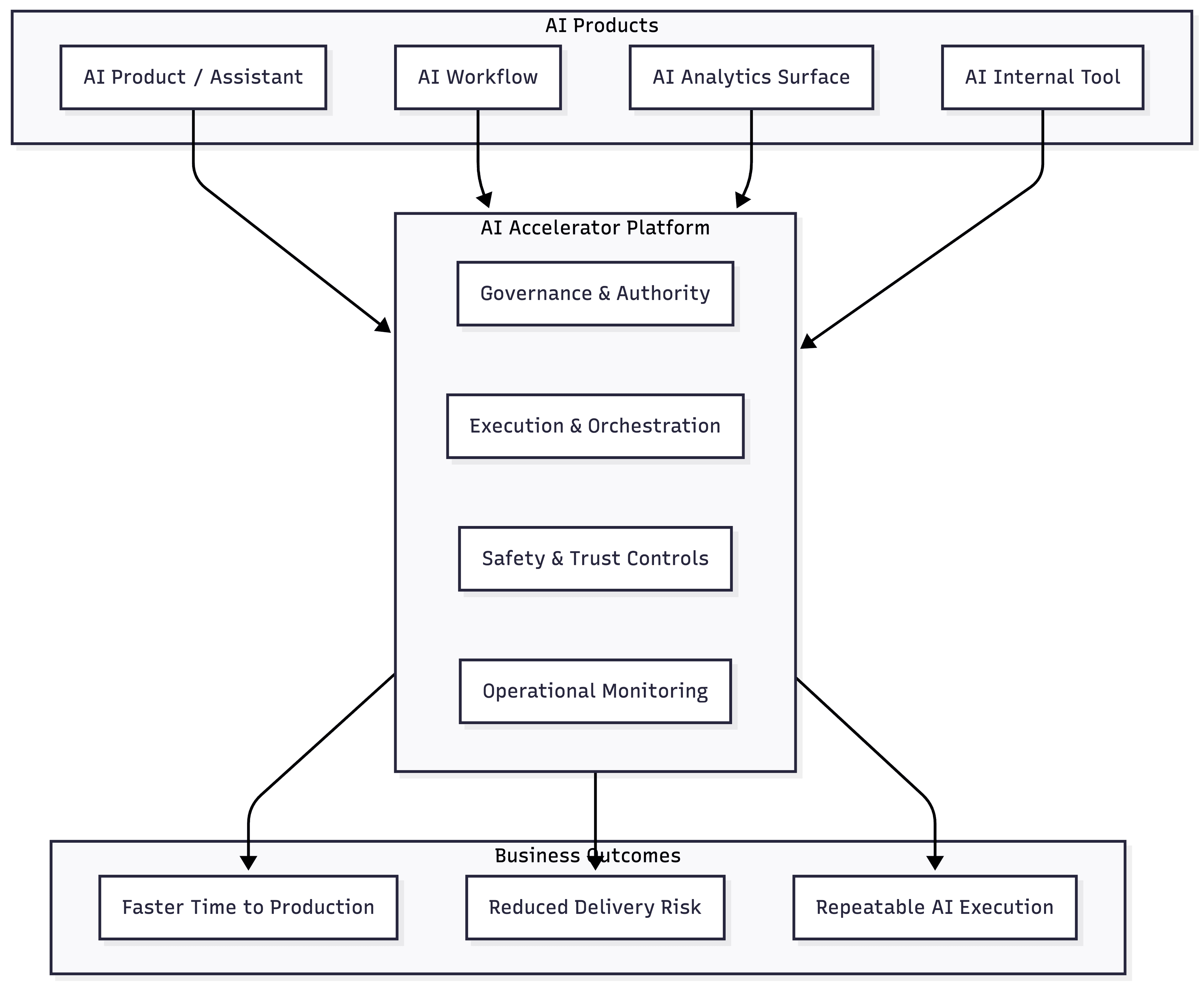
AI products depend on the shared platform foundation, allowing execution to scale without each product recreating the basics.
Products change. The execution foundation does not.
Owning the execution layer changes the economics of every AI product built on top of it.
What the platform enables
With the AI Accelerator Platform in place, teams are not starting from a blank page. They are starting from a proven base that already reflects what it takes to ship and operate AI in demanding environments.
Faster AI product launches
Teams move from concept to a production-ready build in weeks, not quarters, because core patterns are already decided and battle-tested. The focus shifts from plumbing to the specific business problem.
Safe deployment in high-trust environments
Deployment in environments where reliability, traceability, and institutional oversight are non-negotiable.
Multiple applications without starting from scratch
Once the platform is established, additional AI products—assistants, workflows, analytics surfaces, or tools—can be built on the same foundation instead of rebuilding from the ground up.
Standardized AI delivery across teams and portfolios
Common patterns, guardrails, and practices reduce variability in how AI gets shipped. Leaders gain a consistent way to evaluate progress, compare initiatives, and govern risk across a complex landscape.
Time, cost, and risk—before and after the platform
Without a platform, AI initiatives behave like bespoke projects. Each one starts with new architecture, vendors, and learning curves that are paid for again and again. Timelines stretch, scope narrows, and post-launch support is often an afterthought.
With the platform in place, core execution patterns are reused. Architectural choices and operating models have already been tested on real products, so teams execute known plays instead of designing from scratch.
In practice, this means shorter hardening cycles, fewer abandoned initiatives, and budgets directed toward extending a shared execution asset rather than repeatedly rebuilding foundations.
Without a Platform
Each initiative stands up its own foundations, stretching timelines and increasing points of failure.
Time to production
Setup and rework
With the AI Accelerator Platform
Teams build on a shared base, so time concentrates on business logic instead of repeated setup.
Time to production
Setup and rework
The illustration highlights how a shared platform compresses time-to-production and reduces repeated setup, without changing the underlying ambition of the work.
Built and battle-tested on real products
The platform has been exercised across diverse production environments, validating its structural durability across domains, stakeholders, and operating models.
Developer enablement
Tools that help engineering teams ship AI-backed features with a consistent way of working.
Revenue & marketing operations
Systems that support campaigns, sales motions, and customer outreach without adding operational drag.
Healthcare & high-trust domains
Assistive workflows that help clinicians and staff while respecting the sensitivity of their work.
Internal AI workspaces
Environments where product and data teams explore new use cases on top of a shared foundation.
Who the AI Accelerator Platform is for
This is a strategic capability for organizations that need AI to support real revenue, cost, and risk outcomes—not a self-serve software subscription.
This is execution infrastructure, not self-serve software.
- Enterprise technology and product organizations in Fortune 200 / 500 companies.
- Private equity firms seeking repeatable AI leverage across portfolio companies.
- Corporate development and innovation teams under pressure to show durable AI wins.
- Strategic acquirers evaluating long-term AI infrastructure and IP assets.
How different buyers use the platform
The platform serves different buyers through a shared execution backbone and a common execution model.
Enterprises
Large technology and product organizations use the platform as an internal accelerator: a way to standardize how AI is delivered, de-risk flagship initiatives, and give multiple teams a shared foundation to build on.
Private equity firms
PE operators use the platform to introduce a common AI playbook across the portfolio, reducing duplication and enabling portfolio companies to benefit from shared infrastructure rather than isolated experiments.
Strategic acquirers
Corporate development teams and strategics treat the platform as long-term AI infrastructure: an asset that can be integrated, extended, or acquired to accelerate their own roadmap and improve the quality of future AI investments.
Illustrative products built on the platform include
The platform has been exercised across multiple product categories, each reinforcing the durability of the underlying execution foundation.
Developer enablement and engineering tooling
AI-powered developer platforms that give engineering teams a consistent, governed way to design, test, and ship AI-driven features inside existing applications. The platform absorbs safety and operational complexity so teams can focus on product logic rather than rebuilding AI infrastructure for every use case.
Revenue, marketing, and sales operations automation
AI systems that connect assistants to campaign data, playbooks, approval workflows, and internal systems of record. These products improve throughput and responsiveness while preserving control, auditability, and alignment with existing operating processes.
Healthcare and other high-trust AI assistants
AI assistants designed to support clinicians and operations staff with documentation, triage, coordination, and decision support, while honoring strict trust, oversight, and escalation requirements. These implementations operate in environments where failure carries real regulatory, reputational, and human risk.
Internal AI workspaces and enablement platforms
Shared AI environments for product, data, and operations teams that allow new use cases to be prototyped, hardened, and operationalized on top of common infrastructure. Instead of starting from zero with each initiative, teams build on a foundation that improves with every deployment.
Each implementation strengthens the underlying platform. Lessons learned in one domain are folded back into the foundation so future products benefit from everything that came before.
Engage at the execution layer
Inference Stack partners selectively to embed execution authority into enterprise AI systems. Initial discussions center on architecture, portfolio alignment, and structural control, not feature demos.
Engagements are selective and structured around measurable business outcomes, not seats or feature tiers.
Engagement structure and commercial terms are discussed once there is clear alignment on objectives and scope. The platform is offered as a partnership, not a self-serve SaaS product.
Detailed technical and economic materials are available under NDA for qualified institutions.